Hello. Your user experience on our site might be different because you are on Internet Explorer, switch to Chrome or Safari for a better experience.


Lifestyle
What to Look for in New-Build Townhomes in Chilliwack Before You Commit
August 4, 2026
Shopping for townhouses Chilliwack has to offer feels different than house-hunting used to. New construction dominates the shortlist for buyers priced out of Surrey and Langley, but "new" isn't automatically "better." It's better only when you know what to check before you sign.
A glossy show suite tells you almost nothing about what's behind the walls, how the strata will be run or whether the developer will still be standing behind their work in year eight. The buyers who feel confident on possession day aren't the lucky ones. They're the ones who asked the right questions about developer reputation, build quality, warranty coverage, energy performance and long-term community planning before they removed subjects.
This guide walks through exactly what to look for when buying townhouses Chilliwack builders are bringing to market right now, using Cedarbrook as a working example of what a thoughtfully planned community actually looks like on paper and in person.
A developer's track record predicts your ownership experience more reliably than any show suite finish package can. Buyers should shop for a builder as carefully as they shop for the home itself, checking past projects, customer references and how disputes were resolved. A beautiful layout built by an inconsistent developer is still a risk.
Start by asking how long the developer has operated in the region and whether they've delivered multi-phase communities before, not just single buildings. A developer who has committed to years of phased development, parks and amenity build-out has a financial incentive to protect long-term value across the whole neighbourhood, not just the units they've already sold.
Westbow, the developer behind Cedarbrook, has built its reputation on consistent build quality and long-term community commitment rather than one-off projects. That distinction matters because a master-planned community only delivers on its promise if the same team is still around to finish the parks, trails and later phases years after your closing date.
Ask these three questions before you tour a show suite: How many completed communities has this developer delivered in the Fraser Valley? What do past buyers say about warranty response times? Is there a long-term site plan you can review, not just a rendering? If a sales team can't answer clearly, that's information too.
Build quality shows up in details most buyers walk past, window and door seals, floor transitions and how quiet a unit feels with the HVAC running. Staging can make any unit look move-in ready in photos. It can't fix a poorly sealed building envelope or a rushed trade schedule.
Walk the show suite with a specific checklist: check for consistent grout lines and drywall seams, test how doors and windows seal and ask about the mechanical systems installed rather than just their brand names. Ask whether the same trades are used across phases, consistency in construction crews is one of the more reliable, if less visible, quality signals in new-build housing.
It's also worth asking what's covered by manufacturer warranties versus the builder's own workmanship warranty, since those two things are often confused and cover very different failure points. A developer with a long-term plan for the community, the kind Cedarbrook has built around its trail network and central park, tends to hold contractors to a higher standard because the finished product reflects on years of future phases, not just the current release.
Every new home built by a licensed BC builder carries the mandatory 2-5-10 warranty: 2 years on materials and labour, 5 years on the building envelope and 10 years on the structure. This coverage applies to all homes with building permits applied for on or after July 1, 1999 and it transfers automatically to a future buyer if you sell within the coverage window.
Here's why that number matters more than it looks on paper. The building envelope is where the most expensive failures typically originate in a poorly built home and it's backed by third-party warranty insurance for five full years, not your own pocket. The structural coverage runs a full decade. For a strata corporation, that means the costliest failure points are insured well past your first several ownership years, reducing the odds of an early special levy tied to construction defects.
Ask specifically who underwrites the warranty, what the claims process looks like and whether any past claims have been filed on earlier phases of the same community. A developer who answers this plainly, the way Cedarbrook's team does with buyers comparing options like Cedarbrook townhomes for sale against older resale stock, is one worth taking seriously.
BC's Energy Step Code sets a five-tier efficiency scale for new construction, with the province targeting Step 5 (net-zero energy ready) as the mandatory baseline for all new homes by 2032. New builds today are already required to meet meaningfully higher performance tiers than homes built even five years ago, which translates directly into lower heating and cooling bills.
Ask which step the development is built to, not just whether it's "energy efficient" in marketing copy. Ask about the heating system type, insulation values and window performance ratings and request the home's projected EnerGuide rating if one exists. A newer building performing at Step 3 or higher will typically show noticeably lower utility costs than an older resale home running on original single-stage furnaces and outdated insulation.
This is one of the quieter cost differences between new and resale that rarely shows up until your first full winter in the home, so it's worth asking about before you commit rather than after your first utility bill arrives.

BC now requires every strata corporation with five or more units to contribute a minimum of 10% of its annual operating budget to the contingency reserve fund, effective under regulations that took hold in late 2023. That minimum exists because underfunded reserves are the mechanism behind most special-levy surprises buyers hear about after the fact.
New construction gives you a real advantage here: a brand-new strata starts its reserve-funding clock fresh, with mandatory warranty coverage absorbing the early-year risk that older buildings are now scrambling to address. Many older Chilliwack-area buildings are confronting funding gaps as depreciation report rules tighten, which is exactly the risk a new strata doesn't carry yet.
Before you commit to any Chilliwack town houses, request the HOA's fee structure, rules on rentals and pets, parking policy and the current depreciation report and special-levy history for the past five years. A transparent developer will hand this over without hesitation; Cedarbrook's approach is to make fees and community guidelines available upfront so there's nothing buyers are working to uncover later.
A widely used rule of thumb is to budget 1% to 2% of a home's value annually for maintenance and repairs. On a $600,000 townhome, that's $6,000 to $12,000 a year in real or deferred maintenance costs on a resale property with aging systems.
New construction shifts that number meaningfully. Because the roof, windows, plumbing and mechanical systems are brand new and covered under the 2-5-10 warranty, buyers typically see maintenance costs trend toward the low end of that range or below it, through the first several years of ownership. That gap compounds every year you own the home and it rarely shows up in a side-by-side comparison of purchase price alone.
Chilliwack's townhouse market is averaging at $574,846, giving buyers a real benchmark for comparing new-build pricing against resale stock in the same category. When you're weighing options, run the ownership-cost math over a five-year horizon, not just the closing-day numbers. That's where new construction's advantage tends to show up most clearly.
A townhome is only as livable as the community surrounding it, which is why walkability, green space and amenity planning deserve the same scrutiny as square footage. Buyers who choose a connected, amenity-rich community are buying value that holds up over time, not just finishes that photograph well on day one.
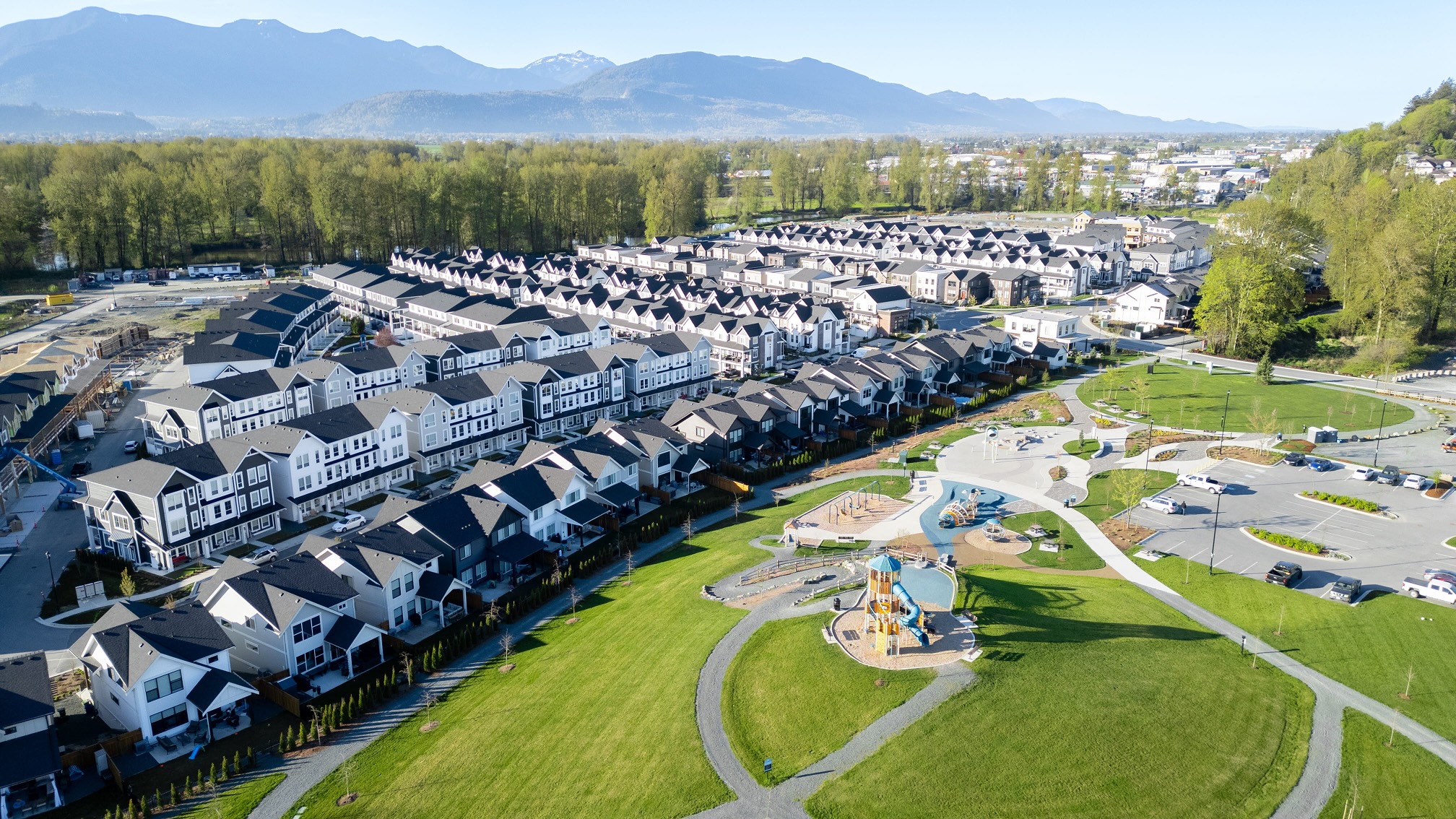
Cedarbrook's master plan includes over 4 kilometres of scenic walking trails, a central community park, a splash park, an adventure playground and a fenced-in dog park, all designed around the idea that a home should support daily life, not just house it. Ask any developer for their long-term amenity plan in writing and ask what's built today versus what's still on a future-phase timeline, the difference matters when you're comparing communities on paper.
Diverse housing options within the same master-planned community, from townhomes to move-in ready homes to rental apartments, also signal a developer building for a full range of life stages rather than a single buyer profile. That's part of what separates a genuine community plan from a subdivision with a nice name.
Before you commit to any new-build townhome, walk through five checks: the developer's completed track record, specific build quality signals in the show suite, the exact warranty terms in writing, the building's energy performance tier and the HOA's reserve fund health and fee transparency. Skipping any one of these is the most common way buyers end up with regret instead of confidence.
Cedarbrook was planned around the idea that these checks shouldn't be hard to pass. A community backed by Westbow's build-quality reputation, full warranty coverage, energy-efficient construction and amenities designed for real family life gives buyers a benchmark for what a thoughtfully developed Chilliwack community should look like.
Ready to see it for yourself? Contact Cedarbrook today or book a tour and walk through a community built around the questions smart buyers ask before they commit.
Check the developer's track record across past communities, specific build quality signals like window seals and consistent finishes, the exact warranty terms in writing and the strata's reserve fund health and fee transparency. Reviewing all five areas before you tour a show suite gives you a much clearer picture than judging on finishes alone.
Ask how many completed communities the developer has delivered, request references from past buyers and ask specifically about warranty claim response times. A developer with a long-term, multi-phase site plan rather than a single one-off project generally has a stronger incentive to protect build quality and long-term value.
It covers materials and labour for 2 years, the building envelope (exterior walls, roof, windows and doors) for 5 years and the structure for 10 years and it's mandatory for all homes built by licensed BC builders. The coverage transfers automatically to a future buyer if you sell within the warranty window.
Fees vary by building, but focus less on the monthly number and more on what's behind it. Ask for the reserve fund balance, contribution history and any special levies from the past five years. BC now requires stratas to contribute at least 10% of their operating budget to the reserve fund annually, which is one indicator of how well-funded a building actually is.
Yes, new construction must meet increasingly strict tiers of BC's Energy Step Code, with the province targeting net-zero-ready performance as the mandatory baseline by 2032. Homes built to higher step levels typically use less energy for heating and cooling than older resale homes with original systems and insulation.

Come experience the community for yourself.
